





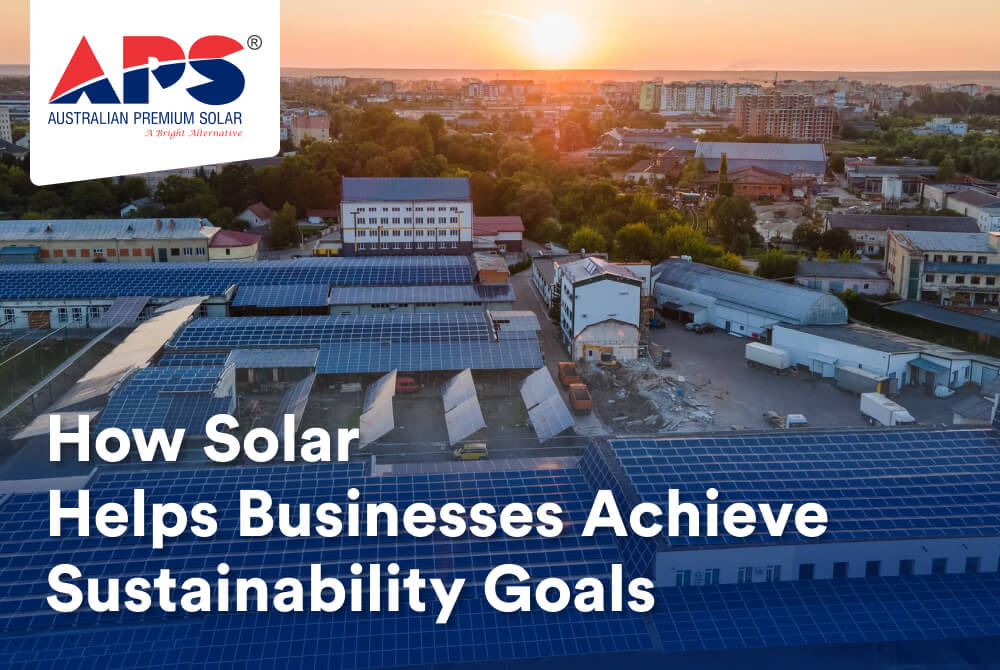
Across India, sustainability is no longer just a boardroom buzzword it is a business imperative. With SEBI’s BRSR mandate, global supply chains demanding Scope 2 emission disclosures, and customers actively choosing greener brands, the pressure on Indian businesses to decarbonise has never been greater. Commercial solar solutions are the single most practical, high-ROI action a business can take toward its sustainability goals today. This guide explains exactly how and why the best commercial solar panels from APS are built specifically for Indian businesses.
Why Sustainability Has Become a Business Priority in India
The Indian sustainability landscape has undergone a seismic shift in the past three years. What was once a voluntary CSR gesture has become a regulatory requirement for publicly listed companies and a commercial prerequisite for businesses in global supply chains.
BRSR Mandate (SEBI): Since FY 2022–23, SEBI requires the top 1,000 listed companies in India to file a Business Responsibility and Sustainability Report (BRSR) as part of their annual reports. From FY 2024–25, the top 250 listed entities must also disclose Scope 3 GHG emissions on a comply-or-explain basis. For listed companies and their supply chain partners, energy transition is now a compliance conversation — not just an ethics one.
Beyond regulatory pressure, market forces are reshaping how businesses think about energy. Indian MSMEs supplying to large domestic or multinational corporations increasingly face requirements to demonstrate progress on Scope 2 emissions reduction showing that electricity consumption is shifting to renewable sources. Rooftop and commercial solar is the most credible, verifiable way to meet these requirements.
And then there is the plain financial logic: India’s commercial and industrial electricity tariffs have risen steadily, with many states charging ₹8–12 per unit for high-tension consumers. Solar power panels reduce per-unit cost to ₹2–4 over the system’s life. For energy-intensive businesses, that difference runs into crores annually.
India’s solar momentum: According to the Ministry of New and Renewable Energy, as of May 2025, India’s installed solar capacity reached 110.83 GW with commercial and industrial rooftop solar accounting for a growing share. By 2024, 21% of Indian MSMEs were powered by solar energy, leading to an average 30% reduction in power bills and a decrease in CO₂ emissions of 110 million tonnes annually.
How Commercial Solar Directly Supports Sustainability Goals
When businesses install the best commercial solar panels, the impact on their sustainability metrics is immediate, measurable, and reportable. Here is how solar addresses the three pillars of ESG.
Environmental Decarbonise your operations directly
Every unit of electricity a business generates from commercial PV panels instead of the grid avoids approximately 0.82 kg of CO₂ emissions, India’s current national grid emission factor. For a 100 kW commercial solar installation generating 1.4 lakh units annually, that translates to roughly 115 tonnes of CO₂ avoided every year. Over 25 years, that single installation avoids nearly 2,900 tonnes of carbon, equivalent to planting over 1.3 lakh trees.
This is not an estimate on paper. It is auditable, verifiable data directly reportable in your BRSR filing under energy consumption, GHG emissions intensity, and renewable energy procurement indicators.
Social Energy security and employee well-being
Reliable solar power reduces dependence on diesel generators, improving air quality in and around your facility, reducing noise pollution, and demonstrating a visible commitment to employee and community health. For businesses in Tier-2 and Tier-3 cities where grid reliability is inconsistent, commercial solar combined with battery storage ensures operational continuity without polluting fallback fuels.
Governance Transparent, quantifiable ESG reporting
Solar installations generate real-time, meter-verified energy production data. For publicly listed companies, this provides the quantifiable metrics SEBI’s BRSR framework requires. For private businesses preparing for IPO or seeking institutional investment, solar adoption builds a credible environmental track record before formal reporting obligations apply.
Key Benefits of Solar Panels for Business
Dramatically lower electricity costs
Commercial solar solutions reduce per-unit electricity cost from ₹8–12 (grid) to ₹2–4 (solar) over the system’s lifetime. For a factory consuming 50,000 units/month, that saving compounds to ₹25–50 lakh annually.
Tariff protection & energy security
Grid electricity tariffs are index-linked to coal and infrastructure costs they only go up. Solar power panels lock in a predictable, low cost of energy for 25 years, insulating your business from tariff volatility.
Stronger ESG & BRSR scores
Solar installation directly improves GHG disclosure metrics, reduces reported carbon intensity, and supports BRSR compliance for listed companies. For global supply chains, it demonstrates Scope 2 emission reduction credibly.
Brand differentiation
Customers, employees, and investors increasingly favor businesses with visible sustainability commitments. A solar installation is tangible, photogenic, and permanent a brand asset that works 365 days a year.
Accelerated depreciation benefit
Under Section 32 of the Income Tax Act, solar power assets qualify for 40% accelerated depreciation in Year 1, significantly improving the post-tax IRR of any commercial solar investment.
Grid independence & continuity
Grid-tied commercial solar with battery storage or DG backup integration ensures operational continuity during outages critical for manufacturing, cold chains, data centers, and healthcare facilities.
Which Business Sectors Benefit Most from Commercial Solar Solutions
Almost every type of commercial or industrial establishment benefits from solar panels for business but some sectors see an especially compelling financial and sustainability case.
| Sector | Why solar works especially well | Typical system size |
|---|---|---|
| Manufacturing & factories | High daytime energy consumption aligns perfectly with solar generation hours. A large roof or yard area is available for the best commercial solar panels. | 100 kW – 5 MW |
| Warehouses & logistics | Massive flat roof areas with minimal obstructions. Low capex per kW due to scale. Strong ROI even at modest tariff rates. | 200 kW – 2 MW |
| IT offices & tech parks | Air conditioning and server infrastructure create consistent daytime loads. ESG reporting advantages with global clients and investors. | 50 kW – 500 kW |
| Hotels & hospitality | High electricity consumption from HVAC, kitchens, and lighting. Strong guest-facing sustainability narrative. Reduces F&B operational costs. | 50 kW – 1 MW |
| Hospitals & healthcare | 24×7 critical loads benefit from solar + storage combos. Cost reduction supports affordable healthcare. ESG reporting for listed hospital groups. | 100 kW – 2 MW |
| Schools & institutions | Daytime-only operations align ideally with solar output. Large rooftop areas. State government incentives are available for educational institutions. | 20 kW – 500 kW |
| Retail & malls | Significant lighting and cooling loads during business hours. Rooftop and carport solar are both viable. Green building certification support. | 100 kW – 1 MW |
APS Commercial Solar Solutions What Sets Us Apart
Australian Premium Solar (India) Ltd is not simply a panel manufacturer APS is a complete commercial solar solutions partner. From module manufacturing to EPC execution and post-installation support, every step is handled under one accountable, NSE-listed brand with over a decade of Indian market experience.
APS Commercial Solar
APS manufactures best-in-class commercial PV panels Monofacial PERC, Bifacial, and the latest TOPCon N-type modules at its state-of-the-art 3,09,276 sq. ft. facility in Sabarkantha, Gujarat. With a total manufacturing capacity now expanded to 800 MW and a 4 GW TOPCon solar cell facility in Ahmedabad in the pipeline, APS is one of the few fully integrated solar manufacturers in India producing next-generation TOPCon modules at scale. Every APS panel is IEC and ALMM certified, making commercial installations eligible for government incentive schemes.
Manufacturing capacity
1.2 GW
Panel types
Mono PERC · Bifacial · TOPCon
Certifications
IEC + ALMM certified
Services
Full EPC · supply-only · AMC
Listed
National Stock Exchange
APS commercial solar panel range for businesses
APS Monofacial PERCHigh efficiency
Best value
The proven workhorse for commercial solar installations. Single-crystal PERC technology delivers consistent high output across India’s variable weather. Ideal for factories, warehouses, and institutions seeking maximum ROI at competitive capex.
Best for: Factories, warehouses Standard C&I rooftop
APS Bifacial SolarUp to 20% higher yield
Generates electricity from both front and rear surfaces. On elevated commercial structures, open yards, and carport installations, bifacial commercial PV panels deliver significantly higher energy yield per sq. metre improving system ROI without additional land use.
Best for: Carports, open yards Ground-mount C&I
APS TOPCon N-typeNext-gen · Lowest degradation
APS’s flagship commercial solar panels for businesses with limited rooftop space or premium ESG reporting requirements. TOPCon N-type technology delivers maximum efficiency per sq. metre, lowest annual degradation rate, and superior performance in India’s high-temperature summer conditions.
Best for: IT parks, hospitals Premium ESG reporting
For more information reach out to us today on https://australianpremiumsolar.co.in/contact-aps/