





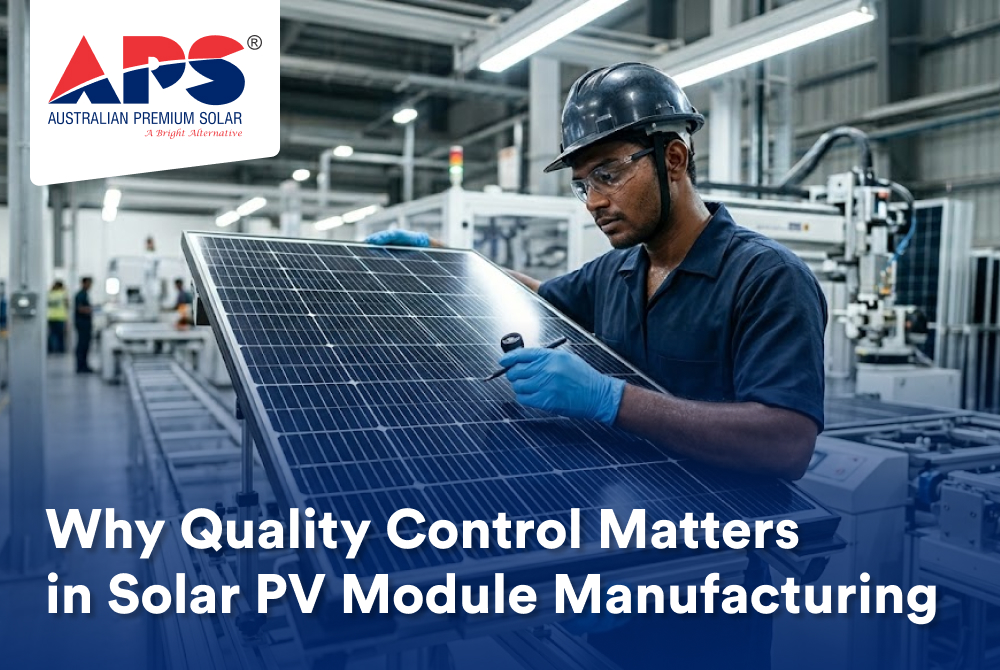
India’s solar industry is experiencing remarkable growth as businesses, industries, and homeowners increasingly adopt clean energy solutions. However, the long-term performance of a solar power system depends on more than just installation quality. it starts with the manufacturing process itself. The reliability, efficiency, and lifespan of a solar PV module are directly influenced by the quality control measures implemented during production.
As one of India’s leading solar manufacturers, Australian Premium Solar India Ltd. (APS) understands that delivering consistent performance requires rigorous testing, advanced manufacturing processes, and uncompromising quality standards. This commitment to quality is what differentiates high-quality solar PV modules from ordinary products in the market.
Understanding Solar PV Module Manufacturing
A solar PV module is made up of multiple interconnected solar cells that convert sunlight into electricity. While the concept may seem straightforward, the manufacturing process involves numerous stages, including:
- Solar cell inspection
- Stringing and tabbing
- Layup and lamination
- Framing
- Junction box installation
- Electrical testing
- Final quality inspection
Any defect introduced during these stages can impact the module’s performance, safety, and durability over its operational life.
This is why solar PV module quality control is a critical aspect of modern solar manufacturing.
What Is Solar PV Module Quality Control?
Solar PV module quality control refers to the systematic process of inspecting, testing, and validating modules throughout the manufacturing cycle to ensure they meet predefined quality, performance, and safety standards.
Quality control measures help manufacturers identify potential defects before products reach customers, ensuring consistent performance in real-world conditions.
The objective is simple: deliver reliable and high-quality solar PV modules that perform efficiently for decades.
Why Quality Control Matters in Solar PV Module Manufacturing
1. Ensures Higher Energy Output
The primary purpose of a solar PV module is to generate electricity efficiently. Even minor manufacturing defects can reduce power output and overall system performance.
Quality control helps ensure:
- Proper cell alignment
- Consistent electrical connections
- Uniform power generation
- Reduced energy losses
This enables modules to achieve their rated performance and maximize energy production throughout their lifespan.
2. Improves Long-Term Reliability
Solar panels are expected to operate for 25 years or more under varying environmental conditions.
Without strict quality control, modules may develop issues such as:
- Microcracks
- Delamination
- Hotspots
- Moisture ingress
- Premature degradation
Rigorous testing helps identify these risks before the modules are deployed, resulting in greater reliability and customer confidence.
3. Enhances Safety Standards
A defective solar module can create electrical and fire safety concerns.
Comprehensive quality control procedures help ensure:
- Proper insulation
- Secure electrical connections
- Structural integrity
- Compliance with national and international safety standards
This is particularly important for residential, commercial, and industrial solar installations where long-term operational safety is essential.
4. Delivers Better Return on Investment
Solar systems are long-term investments. Customers expect stable energy generation and predictable savings over many years.
When manufacturers maintain strong quality control processes, customers benefit from:
- Higher energy yields
- Reduced maintenance requirements
- Longer module lifespan
- Improved financial returns
This makes quality one of the most important factors when selecting a solar module manufacturer.
Key Quality Control Tests in Solar PV Module Manufacturing
Electroluminescence (EL) Testing
EL testing helps identify invisible defects such as microcracks and cell damage that may not be visible during standard inspections.
This process allows manufacturers to detect performance-related issues before modules leave the production line.
Flash Testing
Flash testing measures the electrical performance of every solar PV module under simulated sunlight conditions.
The test verifies:
- Power output
- Voltage
- Current
- Efficiency ratings
This ensures that each module meets its specified performance standards.
Visual Inspection
Trained quality control teams inspect modules for:
- Surface defects
- Cell alignment issues
- Lamination irregularities
- Frame imperfections
Visual inspections act as an additional layer of quality assurance.
Environmental Stress Testing
Modules may be subjected to:
- High-temperature exposure
- Humidity testing
- Mechanical load testing
- Thermal cycling
These tests simulate real-world operating conditions and help verify long-term durability.
The Importance of Manufacturing Excellence
As India’s solar market becomes increasingly competitive, manufacturing excellence has become a key differentiator.
Leading manufacturers invest heavily in:
- Automated production lines
- Advanced testing equipment
- Skilled quality assurance teams
- Continuous process improvement
These investments help ensure that every solar PV module meets strict quality standards before reaching customers.
How APS Maintains High Manufacturing Standards
Australian Premium Solar India Ltd. follows stringent quality practices throughout the manufacturing process to ensure consistency and reliability.
Our quality-focused approach includes:
Advanced Manufacturing Technology
Modern production facilities help maintain precision and consistency across every stage of module manufacturing.
Multiple Quality Inspection Stages
Quality checks are performed throughout the production process rather than only at the final stage.
Performance Verification
Each module undergoes electrical testing to verify output and performance specifications.
Commitment to Continuous Improvement
Manufacturing processes are regularly reviewed and optimized to enhance product quality and operational efficiency.
This dedication enables APS to deliver high-quality solar PV modules designed to perform reliably in diverse climatic conditions across India.
Choosing the Right Solar PV Module Manufacturer
When evaluating solar modules, customers should look beyond price alone and consider:
- Manufacturing standards
- Quality control processes
- Product certifications
- Testing procedures
- Brand reputation
- Warranty support
A strong commitment to solar PV module quality control often translates into better long-term system performance and greater peace of mind.
Why APS Is Trusted by Customers Across India
As one of the leading solar manufacturers in India, APS has built its reputation on quality, innovation, and customer satisfaction.
Customers searching for the best PV Modules in Ahmedabad or in any other part of nation often prioritize manufacturers that combine advanced technology with rigorous quality standards. APS focuses on delivering reliable solar solutions that help customers maximize energy generation and long-term value.
Our commitment to quality ensures that every module leaving our manufacturing facility is designed to meet the expectations of today’s solar consumers.
Conclusion
Quality control is the foundation of reliable solar manufacturing. From raw material inspection to final performance testing, every step plays a crucial role in determining how a solar PV module will perform over its lifetime.
As demand for solar energy continues to rise, choosing manufacturers that prioritize solar PV module quality control becomes increasingly important. High manufacturing standards help ensure greater efficiency, improved durability, enhanced safety, and stronger returns on investment.
For customers seeking high-quality solar PV modules, partnering with a trusted manufacturer like Australian Premium Solar India Ltd. can make all the difference in achieving long-term solar success.