





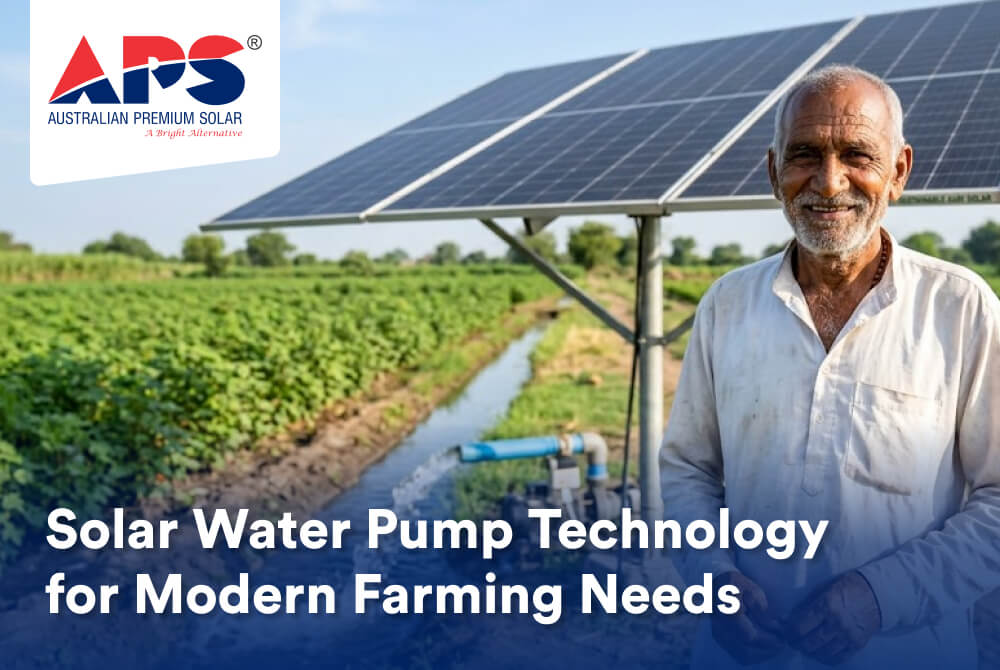
Agriculture has always been the backbone of India’s economy, and access to reliable water sources remains one of the most critical requirements for successful farming. However, rising electricity costs, inconsistent power supply, and increasing fuel prices continue to challenge farmers across the country. This is where solar water pump technology is transforming the agricultural landscape by providing a sustainable, cost-effective, and reliable solution for irrigation.
As one of India’s leading solar solution providers, Australian Premium Solar India Ltd. (APS) is committed to supporting farmers with innovative solar farming solutions that improve productivity while reducing operational costs.
What Is Solar Water Pump Technology?
Solar water pump technology uses energy generated by solar panels to power water pumps for irrigation, livestock watering, and other agricultural applications. Instead of relying on grid electricity or diesel-powered pumps, farmers can harness sunlight to pump water efficiently throughout the day.
A typical solar water pumping system consists of:
- Solar PV panels
- Solar pump controller
- Electric motor
- Water pump
- Mounting structure
These components work together to convert solar energy into mechanical energy, enabling water to be lifted from borewells, rivers, ponds, or reservoirs for agricultural use.
Why Farmers Are Adopting Solar Water Pumps
Indian farmers are increasingly choosing solar water pumps for agriculture due to their numerous economic and environmental benefits.
Reduced Dependence on Grid Electricity
Many rural areas continue to face power shortages and irregular electricity supply. Solar water pumps operate independently, ensuring uninterrupted access to water during daylight hours.
Lower Operating Costs
Traditional diesel pumps require continuous fuel expenses and regular maintenance. Once installed, solar water pumps utilize free solar energy, significantly reducing operating costs.
Environmentally Friendly Irrigation
Solar-powered irrigation systems produce no emissions and help reduce the agricultural sector’s dependence on fossil fuels, supporting sustainable farming practices.
Long-Term Investment
Modern solar pumping systems are designed for durability and can provide reliable performance for many years with minimal maintenance.
How Solar Water Pumps Support Modern Farming
Efficient Irrigation Management
Reliable water availability is essential for crop health and productivity. Agricultural solar water pumps enable farmers to irrigate crops consistently, helping maintain optimal soil moisture levels.
This is especially beneficial for:
- Field crops
- Horticulture farms
- Vegetable cultivation
- Fruit orchards
- Greenhouse farming
Improved Crop Productivity
Timely irrigation directly impacts crop yield and quality. By ensuring regular water supply, solar water pumps help farmers improve agricultural output and reduce crop losses caused by water shortages.
Supports Sustainable Agriculture
As agriculture moves towards sustainable practices, renewable energy-powered irrigation systems are becoming a key component of modern farming operations.
Types of Solar Water Pumps for Agriculture
Surface Solar Water Pumps
Surface pumps are suitable for lifting water from:
- Rivers
- Canals
- Lakes
- Ponds
- Storage tanks
These systems are commonly used where water sources are available near ground level.
Submersible Solar Water Pumps
Submersible pumps are installed underwater and are ideal for extracting water from deep borewells.
Advantages include:
- Higher pumping efficiency
- Suitable for deeper water sources
- Reliable performance in varied agricultural conditions
Many farmers prefer submersible systems due to their ability to deliver water from significant depths.
Key Benefits of Solar Water Pump Technology
Significant Cost Savings
One of the biggest advantages of solar water pumps for farmers is the elimination of recurring fuel costs. Farmers can utilize solar energy without worrying about rising diesel prices or electricity bills.
Minimal Maintenance Requirements
Solar pumping systems contain fewer moving parts than conventional pumping systems, reducing maintenance needs and associated costs.
Energy Independence
Farmers gain greater control over irrigation schedules without relying on external power sources.
Government Support and Subsidies
Various central and state government initiatives encourage the adoption of solar water pumps for agriculture by providing financial assistance and subsidy programs, making solar irrigation more accessible to farmers.
Solar Water Pumps and Smart Irrigation Practices
Modern farming increasingly relies on efficient water management techniques.
When combined with systems such as:
- Drip irrigation
- Sprinkler irrigation
- Water storage tanks
- Smart controllers
Solar pumps become an integral part of modern farming irrigation solutions that help optimize water usage and improve farm productivity. These technologies not only conserve water but also support higher agricultural efficiency.
Choosing the Right Agricultural Solar Water Pump
Selecting the right solar pumping solution depends on several factors:
Water Requirement
The daily water demand of crops should be carefully evaluated before selecting pump capacity.
Water Source Depth
Pump selection varies depending on whether water is sourced from shallow reservoirs or deep borewells.
Farm Size
Larger agricultural operations may require higher-capacity systems to meet irrigation needs effectively.
Solar Resource Availability
Proper system design ensures maximum utilization of available sunlight and optimal pumping performance.
Working with experienced solar solution providers helps farmers choose systems that meet their specific agricultural requirements.
The Future of Solar Farming Solutions in India
As India’s agricultural sector embraces modernization, renewable energy technologies will play a crucial role in improving farm efficiency and sustainability.
Growing awareness of climate change, rising energy costs, and water conservation is driving increased adoption of solar farming solutions across the country.
Future developments may include:
- Smart solar irrigation systems
- Automated water management
- IoT-enabled monitoring
- Higher-efficiency solar pumps
- Integrated renewable energy farming solutions
These advancements will help farmers improve productivity while reducing environmental impact.
Why APS Supports Sustainable Agriculture
Australian Premium Solar India Ltd. is committed to empowering farmers through innovative solar technologies that address real-world agricultural challenges.
By promoting solar water pump technology, APS aims to help farmers:
- Reduce irrigation costs
- Improve water accessibility
- Enhance agricultural productivity
- Adopt sustainable farming practices
- Build long-term energy independence
Our focus on quality, innovation, and customer support enables us to contribute to the growing adoption of renewable energy solutions in India’s agricultural sector.
Conclusion
Reliable irrigation is essential for modern agriculture, and solar water pump technology is proving to be a game-changing solution for farmers across India. By harnessing solar energy, farmers can reduce operating costs, improve irrigation efficiency, and achieve greater energy independence.
As demand for sustainable agriculture continues to grow, solar water pumps for agriculture will play an increasingly important role in supporting food production, water conservation, and rural development. With the right agricultural solar water pumps and well-designed modern farming irrigation solutions, farmers can build a more productive, profitable, and sustainable future.
For customers seeking high-quality solar solutions, partnering with a trusted manufacturer like Australian Premium Solar India Ltd. can make all the difference in achieving long-term solar success.