





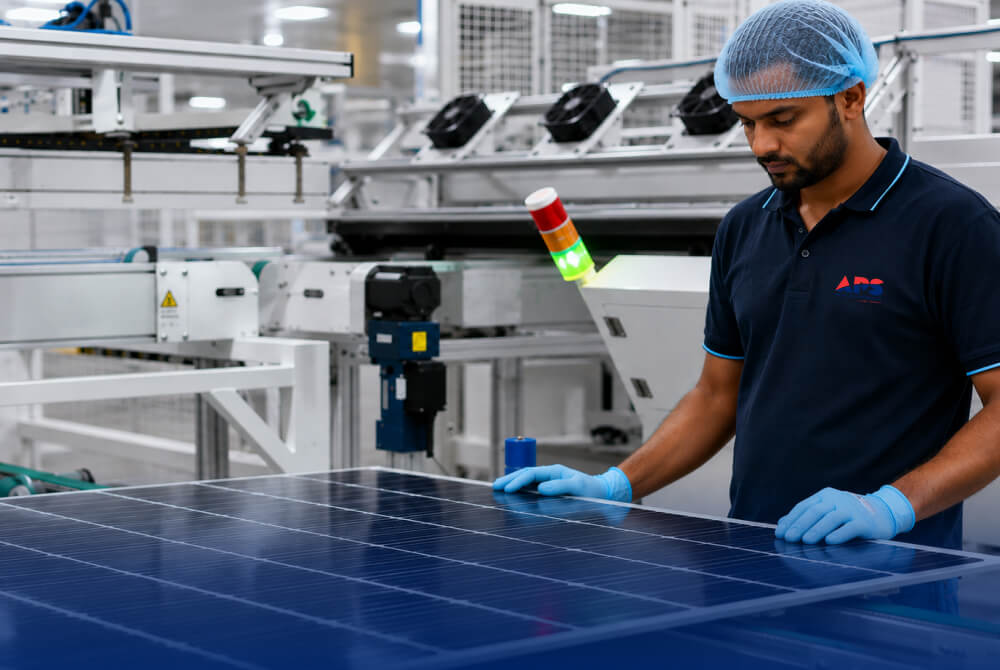
Solar technology continues to evolve as manufacturers develop new ways to improve module efficiency, refine production processes and meet the growing demand for renewable energy. One important development in photovoltaic manufacturing is Tunnel Oxide Passivated Contact (TOPCon) technology, which is designed to reduce electrical losses within solar cells and support improved conversion efficiency.
Understanding TOPCon solar panel technology involves looking at the processes used to manufacture solar cells and assemble them into finished modules. From silicon wafer preparation and surface treatment to passivated contact formation, electrical testing and module assembly, each stage contributes to the characteristics of the final product.
For solar manufacturers, distributors, installers and project developers, understanding how TOPCon solar panels are manufactured provides useful insight into cell design, production requirements and module quality.
What Is TOPCon Solar Panel Technology?
TOPCon stands for Tunnel Oxide Passivated Contact. It is a solar cell technology that uses an ultra-thin oxide layer and a doped silicon layer to improve charge-carrier collection and reduce electrical losses.
When sunlight reaches a solar cell, it generates electrons and holes that contribute to the production of electrical current. Some charge carriers may recombine before they can be collected, reducing the cell’s electrical output. This process is known as recombination.
TOPCon cell architecture is designed to limit recombination at the relevant silicon interface while supporting the collection of charge carriers.
The technology is commonly associated with N-type silicon solar cells. Compared with conventional P-type Passivated Emitter and Rear Cell (PERC) technology, TOPCon requires additional processing steps to form and control its passivated contact structure.
The precise manufacturing sequence, materials and cell configuration vary according to the manufacturer’s design and production methods.
Why TOPCon Technology Matters for Modern Solar Applications
Solar installations need to make effective use of available space while meeting their expected electricity-generation requirements. The choice of solar cell technology can influence module efficiency, system design and product suitability for a particular project.
TOPCon technology is relevant to modern solar applications for several reasons:
- Conversion efficiency: The passivated contact structure is designed to reduce recombination losses and improve the conversion of sunlight into electricity.
- Effective use of space: Higher-efficiency modules can provide more rated power within a given module area, depending on the product specifications.
- Advanced manufacturing processes: TOPCon production involves specialised cell-processing techniques and controlled manufacturing conditions.
- Application flexibility: TOPCon modules can be evaluated for residential rooftops, commercial buildings, industrial installations and utility-scale projects.
- Product performance evaluation: Cell architecture, module construction, materials and quality control contribute to the performance of the finished product.
These potential benefits should be assessed using the specifications of the actual module. Efficiency, temperature coefficient, degradation characteristics and warranty coverage can differ between manufacturers and products.
The Solar Panel Manufacturing Process for TOPCon Modules
The solar panel manufacturing process for TOPCon products involves two main areas: manufacturing the specialised solar cells and assembling those cells into finished photovoltaic modules.
Although the exact sequence varies between production lines, the main stages generally include wafer preparation, surface treatment, passivated contact formation, electrical contact creation, cell testing and module assembly.
1. Silicon Wafer Preparation
Silicon wafers form the foundation of conventional crystalline-silicon solar cells.
During wafer preparation, silicon material is processed into thin wafers with the required dimensions and characteristics. These wafers undergo cleaning and surface preparation before moving to the next manufacturing stages.
The quality and condition of the wafer are important because contamination, surface damage or inconsistencies can affect subsequent processing.
Manufacturers therefore need to manage wafer handling, cleanliness and processing conditions to support consistency across production batches.
2. Surface Texturing and Cleaning
After wafer preparation, the silicon surface may undergo texturing to create a structure that helps reduce light reflection and improve light absorption.
The texturing method depends on the wafer type and the manufacturer’s production process.
Cleaning is also essential at this stage. Unwanted surface materials and contaminants must be managed before additional cell layers are formed.
Consistent surface preparation helps establish suitable conditions for subsequent passivation and electrical processing.
3. Formation of the TOPCon Passivated Contact
The passivated contact structure is a defining feature of TOPCon solar panel technology.
In a typical TOPCon cell design, an ultra-thin silicon oxide layer is formed on the relevant silicon surface. A doped silicon layer is then deposited or otherwise formed over it, depending on the manufacturer’s process.
Together, these layers are designed to provide selective electrical contact while limiting carrier recombination at the silicon interface.
Controlling the thickness, composition and uniformity of these layers is important because variations can influence the electrical characteristics of the cell.
Manufacturers use process monitoring and specialised equipment to achieve the required properties for their particular TOPCon cell architecture.
4. Layer Deposition and Thermal Processing
Depending on the cell design, deposition techniques may be used to form the silicon layers required for the passivated contact structure.
These techniques can include low-pressure chemical vapour deposition (LPCVD) and plasma-enhanced chemical vapour deposition (PECVD), among other approaches.
Thermal processing may also be used to establish or modify material properties and complete specific manufacturing steps.
The equipment, sequence and processing conditions depend on the production line. Not every TOPCon manufacturer follows an identical process.
Careful control of deposition and thermal processing helps maintain repeatable cell characteristics and manage variations between production batches.
5. Junction Formation and Surface Passivation
Solar cells require suitable electrical junctions and surface passivation to collect charge carriers effectively.
In TOPCon manufacturing, doping and passivation processes depend on the selected cell architecture. Additional layers may be formed on other cell surfaces to establish the required electrical properties and limit recombination.
Surface passivation helps reduce charge-carrier losses at the silicon surface, while the electrical junction supports the separation and collection of carriers generated by sunlight.
The interaction between these features contributes to the cell’s ability to convert solar energy into electricity.
6. Metallisation and Electrical Contact Formation
Once the necessary cell structures have been formed, electrical contacts are created to collect the current generated by the cell.
Metallisation commonly involves applying conductive materials in a designed pattern across the cell surfaces. The exact contact arrangement depends on the cell architecture and manufacturing method.
The contacts must provide suitable electrical conductivity while limiting shading and maintaining the required mechanical properties.
Manufacturing control is important because variations in contact formation can affect electrical resistance, current collection and overall cell performance.
7. Cell Testing and Sorting
Before cells are assembled into modules, manufacturers carry out electrical testing and inspections to assess their characteristics.
Depending on the production process, testing may include current-voltage measurements, visual inspection and other checks used to evaluate cell quality.
Cells may then be classified according to selected electrical parameters. This allows manufacturers to group appropriately matched cells during module assembly.
Testing and sorting help identify production deviations before the cells progress further along the manufacturing line. They also support traceability and the investigation of potential quality issues.
8. Cell Interconnection and Module Layup
After passing the relevant checks, solar cells are interconnected to form electrical strings.
These strings are arranged according to the module design, with electrical connections configured to achieve the required output characteristics.
During module layup, the cells and protective layers are positioned in the specified sequence. Depending on the module construction, these layers commonly include front glass, encapsulant, interconnected cells and a rear protective layer or rear glass.
Accurate cell positioning and controlled interconnection help maintain electrical consistency and the physical integrity of the assembly.
9. Lamination, Framing and Junction Box Installation
The assembled module proceeds to lamination, where controlled heat, pressure and other process conditions bond the layers together.
Lamination helps encapsulate the cells and electrical connections, providing protection against environmental exposure. The appropriate conditions depend on the materials and module design.
Following lamination, additional operations may include trimming, framing and junction box installation.
Where a frame is used, it provides structural support. The junction box houses the electrical connections needed to connect the module to the wider solar system.
Each operation must follow the relevant production specifications to support consistent module construction.
10. Final Inspection and Performance Testing
The completed module undergoes final inspections and testing before dispatch.
Depending on the manufacturer’s quality-control programme, these checks may include:
- Visual inspection for assembly defects
- Electrical performance testing
- Verification of module identification and labelling
- Insulation and electrical safety testing
- Review of production records and traceability
- Additional inspections required by the applicable quality system
Electroluminescence imaging may also be used to identify certain cell or interconnection defects that are not readily visible during a standard visual inspection.
These checks help determine whether the finished module meets its specified production requirements. They form part of a broader quality-management process that begins with incoming materials and continues throughout manufacturing.
How Manufacturing Quality Influences TOPCon Module Performance
TOPCon cell technology can only deliver its intended characteristics when the manufacturing process is appropriately controlled. Material selection, layer formation, electrical contacts and module assembly all influence the properties of the finished product.
Several factors are important when evaluating manufacturing quality:
- Layer uniformity: Consistent formation of the passivated contact structure helps maintain the intended electrical characteristics of the cell.
- Electrical contact quality: Proper contact formation supports current collection and helps control electrical resistance.
- Cell matching: Appropriate cell classification and arrangement help maintain electrical consistency within a module.
- Encapsulation and lamination: Controlled assembly helps protect cells and electrical connections from environmental exposure.
- Testing and traceability: Inspection results and production records help manufacturers identify deviations and investigate quality concerns.
These considerations demonstrate why module quality depends on more than cell technology alone. Materials, equipment maintenance, production controls and inspection procedures also contribute to the finished product.
TOPCon Solar Panels for Residential and Commercial Projects
TOPCon modules can be evaluated for different solar applications. The appropriate selection depends on available installation space, system requirements and the verified specifications of the product.
Residential Solar Installations
For residential rooftops, module efficiency and dimensions can influence how much rated solar capacity can be installed within the available roof area.
Other considerations include roof orientation, shading, inverter compatibility, structural requirements and household electricity consumption.
Evaluating these factors alongside module specifications helps determine whether a particular TOPCon product suits the installation.
Commercial and Industrial Solar
Commercial and industrial solar projects may involve large rooftop areas, multiple roof sections and different electricity-demand patterns.
Module selection should account for available installation space, electrical configuration, expected operating conditions and the project’s energy-generation objectives.
For larger installations, consistent module specifications and suitable documentation can also support procurement, installation planning and quality assessment.
Utility-Scale Solar Projects
Utility-scale solar developments require careful planning around module specifications, supply requirements, installation logistics and long-term operating expectations.
Product qualification, warranty documentation, manufacturing traceability and quality assurance may form part of the procurement process.
Across all applications, TOPCon modules should be evaluated against actual product data and project requirements rather than technology classification alone.
What Should Manufacturers and Buyers Check When Evaluating TOPCon Modules?
Solar manufacturers, distributors, installers and project developers should review several factors when assessing TOPCon modules for a project.
- Rated power and efficiency: Confirm the published module power rating and conversion efficiency.
- Temperature coefficient: Review the expected change in electrical output as module temperature increases.
- Electrical characteristics: Check open-circuit voltage, short-circuit current and operating values for system design.
- Mechanical specifications: Consider module dimensions, weight and applicable mechanical load ratings.
- Performance warranty: Review the stated degradation terms and guaranteed output over time.
- Product warranty: Understand the applicable coverage, exclusions and conditions.
- Quality documentation: Review relevant test reports, certifications and manufacturer documentation.
- System compatibility: Confirm that the module’s electrical characteristics are suitable for the intended inverter and array configuration.
These checks help establish whether a specific module meets the technical and practical requirements of the planned installation.
The Role of TOPCon Technology in the Future of Solar Manufacturing
TOPCon represents an important development in crystalline-silicon solar cell manufacturing. Its passivated contact structure provides a way to improve charge-carrier collection while building on established silicon wafer and module-production technologies.
As manufacturers refine cell structures, materials and production equipment, process control remains important for translating cell design into consistent finished modules.
Future developments in solar manufacturing will continue to involve considerations such as conversion efficiency, production yield, material use, reliability testing and manufacturing costs.
TOPCon is one part of this broader development. The most suitable technology for an individual project depends on product performance, cost, application requirements and expected operating conditions.
APS and Modern Solar Module Manufacturing
Australian Premium Solar (APS) operates within the solar energy sector, where photovoltaic manufacturing and solar technology development are important parts of the wider renewable energy industry.
Understanding the manufacturing stages behind solar modules provides useful context for evaluating cell technology, module construction and product specifications. From material preparation and cell processing to module assembly and testing, each stage contributes to the characteristics of the finished product.
For solar manufacturers, distributors, installers and project developers, this knowledge can support more informed discussions about module technology and its suitability for different applications.
For APS-related product evaluations, buyers and project teams should refer to the specifications, technical documentation and warranty information for the particular module being considered.
Conclusion
The manufacturing of TOPCon solar panels involves several specialised stages, from silicon wafer preparation and passivated contact formation to electrical contact creation, cell testing and module assembly.
Each stage contributes to the electrical characteristics, physical construction and quality of the finished module. Consistent materials, controlled processing and appropriate testing are important for ensuring that products meet their specified requirements.
Understanding TOPCon solar panel technology helps solar industry professionals evaluate the relationship between cell architecture and manufacturing methods. A well-controlled solar panel manufacturing process remains an important part of producing consistent modules for residential, commercial, industrial and utility-scale solar applications.
As the solar industry continues to develop, advances in cell technology, production equipment and quality-control practices will remain relevant to photovoltaic manufacturing in India and international markets.