





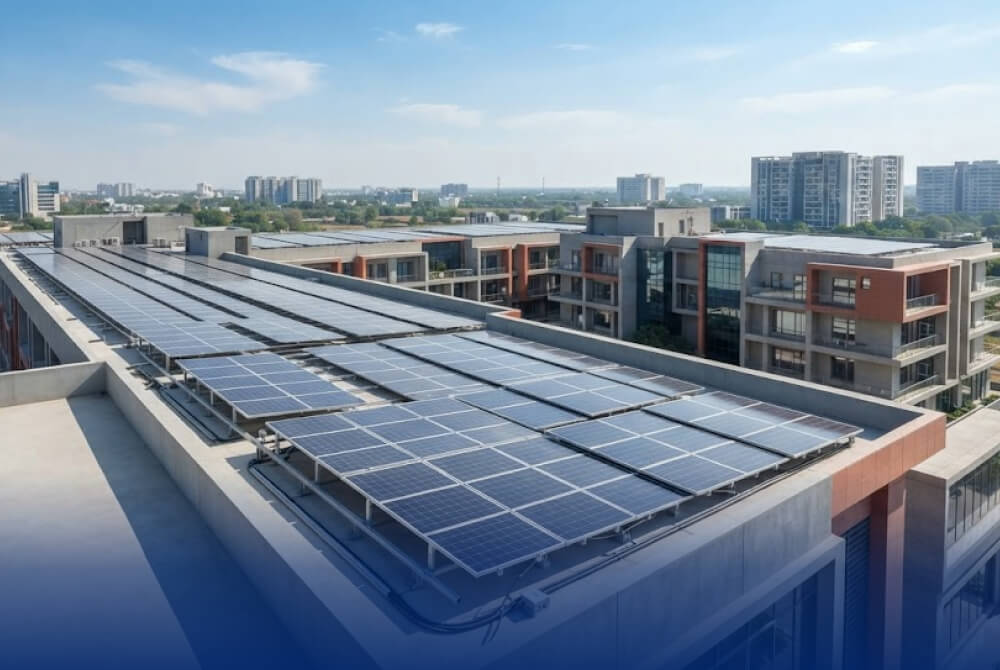
India’s growing energy demand, rising electricity costs, and increasing focus on clean energy are encouraging homeowners and businesses to explore reliable alternatives to conventional power. Among the most practical options, rooftop solar PV systems have emerged as an effective way to generate electricity while making better use of available rooftop space.
Whether you own a home, office, shop, factory, school, or commercial building, installing a solar power system can help reduce dependence on grid electricity and support long-term energy savings.
With India’s abundant sunlight and increasing adoption of renewable energy, residential rooftop solar and commercial rooftop installations are becoming an important part of the country’s transition towards cleaner and more sustainable power.
What Is a Rooftop Solar PV System?
A rooftop solar PV system is a solar electricity system installed on the roof of a residential or commercial property. It uses photovoltaic (PV) modules to convert sunlight into electricity.
A typical rooftop solar installation may include:
- Solar PV modules
- Solar inverter
- Mounting structures
- DC and AC cables
- Protection and safety equipment
- Monitoring system
- Battery storage, where required
During the day, solar panels generate electricity from sunlight. The inverter converts the electricity into a form that can be used by household appliances, office equipment, machinery, and other electrical loads.
Depending on the system configuration and applicable regulations, excess electricity may also be exported to the grid through a net-metering or other approved grid-connected arrangement.
Why Choose Rooftop Solar for Your Property?
1. Reduce Electricity Bills
One of the biggest advantages of installing solar power systems for homes and businesses is the potential to reduce electricity expenses.
A rooftop solar system generates electricity during daylight hours, helping meet a portion of the property’s energy requirements. The more electricity a property consumes during solar generation hours, the greater the opportunity to use the generated power directly.
For businesses with significant daytime electricity consumption, this can make rooftop solar particularly valuable.
Over time, the savings generated through solar can help offset the initial investment in the system.
2. Make Use of Unused Rooftop Space
Roofs often represent unused space that can be converted into an electricity-generating asset.
Instead of using additional land, rooftop solar PV systems allow property owners to utilise existing rooftops for clean power generation.
For homes, this could mean installing solar panels on a terrace or suitable roof area. For commercial and industrial properties, larger roof surfaces can provide an opportunity to install higher-capacity systems.
3. Generate Clean and Renewable Energy
Solar energy is renewable and available in abundance across India.
Unlike conventional electricity generation based on fossil fuels, solar power generation does not require fuel combustion during operation. By generating electricity from sunlight, rooftop solar can help reduce reliance on conventional energy sources and contribute to a cleaner energy mix.
Installing solar is therefore not only an economic decision but also a step towards more sustainable energy consumption.
4. Greater Energy Independence
Dependence on grid electricity can expose property owners to changes in electricity tariffs and other energy-related costs.
A properly designed solar system can generate a significant portion of a property’s electricity requirements, helping reduce dependence on conventional grid power.
For homeowners, this can provide greater control over household energy consumption. For businesses, solar can become an important part of a long-term energy management strategy.
5. Suitable for Both Homes and Businesses
Modern solar energy solutions can be designed for a wide range of applications.
Residential rooftop solar can support everyday household requirements such as:
- Lighting
- Fans
- Refrigerators
- Air conditioners
- Water pumps
- Televisions
- Computers and other appliances
Commercial and industrial systems can support:
- Offices
- Retail stores
- Schools and institutions
- Warehouses
- Manufacturing facilities
- Hospitals
- Workshops
- Other commercial buildings
The system size can be selected based on factors such as electricity consumption, available roof area, solar generation potential, and project requirements.
6. Potential Long-Term Return on Investment
Installing a rooftop solar system requires an initial investment. However, solar panels are designed for long-term operation, allowing property owners to benefit from electricity generation over many years.
The overall financial performance of a solar installation depends on factors such as system size, installation cost, electricity consumption, tariffs, solar generation, maintenance, and applicable government policies.
For this reason, solar should be viewed as a long-term energy investment rather than simply an immediate cost-saving measure.
7. Low Operating and Maintenance Requirements
Solar PV systems generally have relatively low maintenance requirements compared with many conventional power-generation systems.
Regular cleaning of panels, periodic inspection of electrical connections, monitoring system performance, and timely servicing can help maintain reliable operation.
Keeping the panels free from excessive dust and dirt is particularly important in areas where soiling can affect solar generation.
8. Support India’s Renewable Energy Transition
India has set ambitious renewable energy goals and is steadily increasing its solar generation capacity.
When individual households, businesses, institutions, and industries adopt rooftop solar, they contribute to the broader expansion of distributed renewable energy.
By producing electricity closer to where it is consumed, rooftop solar can also play an important role in creating a more sustainable and diversified energy ecosystem.
Residential Rooftop Solar: A Smart Choice for Indian Homes
Electricity consumption in Indian homes continues to increase as households use more appliances, cooling systems, electronics, and other electrical equipment.
Solar power systems for homes can help households generate part of their electricity requirements from sunlight.
Before installing a residential system, homeowners should consider:
- Average monthly electricity consumption
- Available rooftop area
- Roof orientation and shading
- Structural suitability
- Desired system capacity
- Inverter requirements
- Applicable government incentives and regulations
- Future electricity requirements
A professional site assessment can help determine whether the roof is suitable and what system configuration would be appropriate.
Commercial Rooftop Solar: Reducing Energy Costs for Businesses
For commercial properties, electricity can represent a significant operating expense. Offices, retail spaces, warehouses, factories, and other facilities often have substantial daytime electricity consumption—which aligns well with solar generation.
A commercial rooftop solar system can help businesses:
- Reduce grid electricity consumption
- Manage long-term energy costs
- Utilise unused rooftop space
- Improve their renewable energy footprint
- Support sustainability objectives
Businesses should evaluate their load profile, sanctioned electrical load, roof area, operating hours, and future energy requirements before selecting a system.
Rooftop Solar and Government Support in India
The Government of India and various state governments have introduced initiatives to encourage solar adoption.
For residential consumers, schemes such as PM Surya Ghar: Muft Bijli Yojana have further increased awareness and adoption of rooftop solar.
However, eligibility, subsidy amounts, installation requirements, DISCOM procedures, net-metering rules, and other conditions can vary. Homeowners should always check the latest official guidelines applicable to their location before making an investment.
Commercial and industrial consumers may have different policies and regulatory considerations.
What Should You Consider Before Installing Rooftop Solar?
Choosing the right system involves more than simply selecting the number of solar panels.
Roof Condition
The roof should be structurally suitable for the proposed solar installation. Any major repair requirements should ideally be addressed before installation.
Shading
Trees, nearby buildings, water tanks, parapet walls, and other structures can cast shadows on solar panels and affect generation.
System Capacity
The appropriate capacity should be based on electricity consumption, available roof area, budget, and the property’s energy requirements.
Solar Module Technology
Different solar technologies offer different efficiency and performance characteristics. Selecting high-quality modules can contribute to reliable long-term energy generation.
Inverter Selection
The inverter is a critical component of the solar system. Its capacity and technical specifications should be matched appropriately with the PV array and electrical requirements.
Installation Quality
Even high-quality equipment can underperform if the system is poorly designed or installed. Proper engineering, mounting, wiring, electrical protection, commissioning, and after-sales support are therefore important considerations.
Is Rooftop Solar Worth It for Indian Properties?
For many Indian homes and businesses, rooftop solar can be a practical long-term energy solution.
The combination of abundant sunlight, rising electricity demand, improving solar technology, and increasing awareness of renewable energy makes rooftop solar PV systems an attractive option for properties with suitable roof space.
However, every property is different. The potential savings and system performance depend on electricity consumption, location, roof conditions, system design, equipment quality, and local regulations.
A professional solar assessment is therefore recommended before making a final decision.
Power Your Property with Solar
Whether you are looking for solar power systems for homes or a larger commercial installation, rooftop solar can transform unused roof space into a source of clean electricity.
At Australian Premium Solar (APS), we focus on providing reliable solar technology and solutions designed to meet diverse energy requirements. From residential applications to larger commercial projects, choosing the right system design, quality components, and professional installation can make a significant difference to long-term solar performance.
If you are considering residential rooftop solar or a commercial rooftop solar project, assess your property’s energy consumption and rooftop potential today and take the next step towards a cleaner and more self-reliant energy future.
With the right system design, quality components, professional installation, and regular maintenance, solar can become a valuable long-term investment for both residential and commercial properties.