





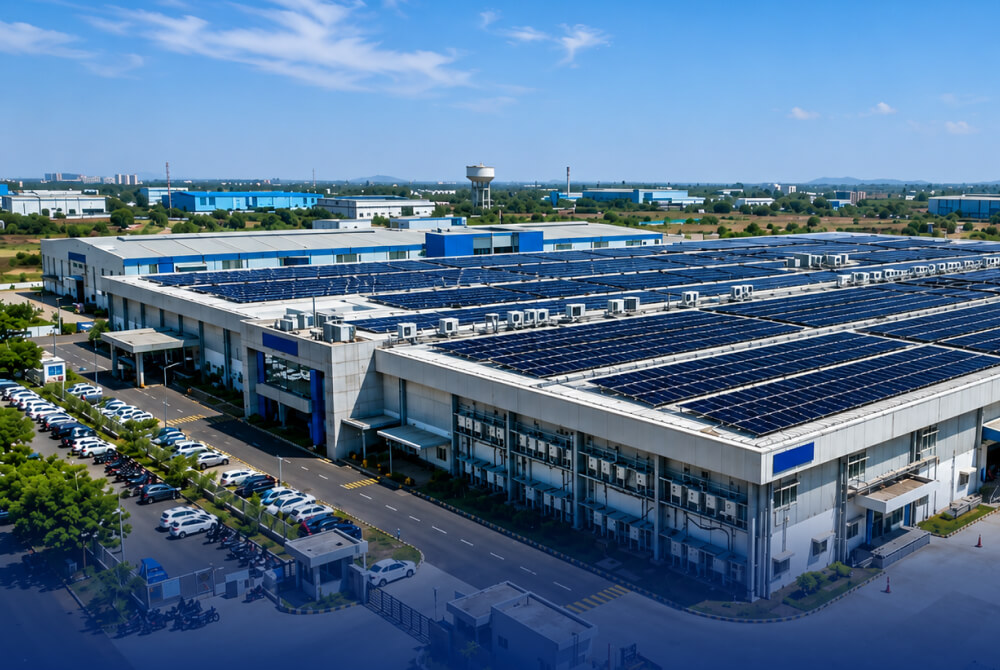
For India’s industrial sector, energy is more than an operating expense. Reliable electricity is essential for keeping production lines running, machinery operating and facilities productive.
At the same time, industries are under increasing pressure to manage energy costs, improve resource efficiency and reduce their environmental impact. This is where industrial solar solutions can play an important role.
From manufacturing plants and warehouses to processing units and large commercial facilities, solar power can help businesses generate electricity on-site, reduce dependence on conventional grid power and support long-term sustainability goals.
With India’s strong solar potential, solar energy for industries is becoming a practical part of modern energy management rather than simply an environmental initiative.
Why Are Industries Turning Towards Solar Energy?
Industrial facilities often have high and predictable electricity consumption. Manufacturing equipment, motors, pumps, HVAC systems, lighting, compressors and other machinery can operate for several hours a day.
For many facilities, a substantial portion of this electricity demand occurs during daylight hours—when a solar PV system can generate electricity.
This creates an opportunity for businesses to use solar power directly at the facility.
A well-designed industrial solar system can help a business:
- Generate electricity on-site
- Reduce grid electricity consumption
- Manage long-term energy costs
- Make productive use of available roof or land
- Reduce dependence on conventional electricity sources
- Support sustainability objectives
- Improve energy management
How Does Solar Power Work for an Industrial Facility?
A typical industrial solar PV system consists of solar modules, inverters, mounting structures, cables, electrical protection equipment and monitoring systems. During daylight hours, solar modules convert sunlight into DC electricity. The inverter converts this into AC electricity that can be used by the facility.
The generated electricity can then be used by the facility’s electrical loads, with surplus generation handled according to the applicable system configuration and grid regulations.
For facilities with suitable energy profiles, this allows solar generation to work alongside the existing electricity supply rather than replacing the grid entirely.
1. Reduce Industrial Electricity Costs
One of the primary reasons businesses invest in solar energy for industries is the potential to reduce electricity expenses.
Industrial facilities can consume large quantities of electricity every month. Generating a portion of this electricity on-site can reduce the amount that needs to be purchased from the grid.
The actual financial benefit depends on factors such as:
- Electricity consumption
- System capacity
- Solar generation
- Electricity tariffs
- Operating hours
- Installation costs
- Financing
- Applicable regulations and incentives
For a facility with substantial daytime electricity consumption, the opportunity to directly use solar-generated electricity can make an industrial solar project particularly attractive.
2. Make Manufacturing More Energy Efficient
Solar does not make machinery itself more efficient. Instead, it can improve the way a facility sources and manages its electricity.
This distinction is important.
A manufacturing facility may operate:
- Production machinery
- Motors
- Pumps
- Compressors
- HVAC systems
- Industrial lighting
- Automation systems
- Material-handling equipment
A solar PV system can supply a portion of the electricity required by these loads during daylight hours.
By integrating solar generation into the facility’s overall energy strategy, businesses can potentially improve energy cost management without changing their core production processes.
3. Support Sustainable Manufacturing
Sustainability has become an increasingly important consideration for Indian industries.
Manufacturers are facing growing expectations from customers, investors, supply-chain partners and other stakeholders to demonstrate responsible energy and environmental practices.
Solar power for manufacturing provides a way to incorporate renewable electricity into daily operations.
By generating electricity from sunlight, industrial facilities can reduce their reliance on conventional electricity sources and support broader renewable energy objectives.
Solar can therefore become part of a company’s wider sustainability strategy alongside:
- Energy-efficient machinery
- Efficient lighting
- Waste reduction
- Water conservation
- Resource optimisation
- Energy monitoring
- Other renewable energy initiatives
4. Utilise Large Industrial Rooftops
Many manufacturing plants, warehouses and industrial buildings have large roof areas.
These rooftops can represent valuable space for solar generation.
Instead of requiring additional land, rooftop industrial solar solutions can make use of existing building infrastructure.
Before installation, however, the roof should be assessed for:
- Structural suitability
- Available installation area
- Shading
- Roof orientation
- Roof condition
- Access for installation and maintenance
For large facilities, ground-mounted solar may also be considered where sufficient suitable land is available.
5. Improve Long-Term Energy Cost Predictability
Electricity costs are an important consideration when planning long-term industrial operations.
While solar does not eliminate electricity costs or guarantee a fixed energy price, generating electricity on-site can provide greater control over a portion of the facility’s energy requirements.
Once the system is installed, sunlight itself does not carry a fuel cost.
This can help businesses plan their energy strategy over the long term, particularly when electricity prices and operating costs are major considerations.
6. Solar Can Support High Daytime Energy Demand
One of the strongest applications for industrial solar is facilities with significant daytime electricity consumption.
Manufacturing plants and commercial facilities may operate during the same hours when solar generation is strongest.
This creates an opportunity for direct solar consumption.
For example:
Solar generation → Manufacturing loads → Reduced grid consumption
Rather than generating solar electricity solely for export, the facility can use a portion of the energy directly for its operations.
The more closely solar generation aligns with electricity consumption, the more relevant this approach can become for system planning.
7. Combine Solar with Energy Monitoring
Modern Commercial & Industrial Solar Solutions can incorporate monitoring systems that provide visibility into solar generation and system performance.
Energy monitoring can help businesses understand:
- How much electricity the solar system generates
- When generation is highest
- How system performance changes over time
- Whether equipment is operating as expected
- How much electricity is being consumed or exported
This information can support better energy-management decisions.
For larger industrial facilities, solar monitoring can also form part of a broader energy-management strategy.
8. Add Battery Storage Where It Makes Sense
Solar generation is naturally dependent on sunlight.
If a facility has significant electricity consumption outside solar-generation hours, battery storage may be considered as part of a broader energy solution.
A compatible battery system can store surplus solar electricity and make it available later.
However, battery storage is not automatically necessary for every industrial project.
The business case should consider:
- Electricity tariffs
- Load profile
- Solar generation
- Battery capacity
- Operating hours
- Backup requirements
- Project economics
For some facilities, direct solar consumption may provide the strongest value. For others, battery storage can add another layer of flexibility.
9. Reduce Dependence on Conventional Power Sources
Industrial facilities need reliable electricity to maintain continuous operations.
Solar can provide an additional source of electricity during daylight hours and reduce the facility’s dependence on conventional grid electricity.
However, solar PV should not be considered a complete replacement for grid electricity in every industrial application.
Production facilities need to consider their load requirements, grid connection, backup systems and operational continuity.
A professional system design can determine how solar should be integrated into the existing electrical infrastructure.
10. Support ESG and Corporate Sustainability Goals
Environmental, social and governance (ESG) considerations are increasingly relevant to businesses.
Installing solar can demonstrate a company’s commitment to renewable energy and responsible resource management.
For manufacturers supplying larger organisations or export markets, sustainability credentials may also become an increasingly important part of supply-chain expectations.
Solar can support sustainability reporting by helping businesses track renewable electricity generation and demonstrate progress towards their energy goals.
Solar Power for Manufacturing: What Should Businesses Consider?
Every manufacturing facility has a different energy profile.
Before investing in solar power for manufacturing, businesses should evaluate several factors.
Electricity Consumption
Review electricity bills and interval consumption data to understand how much energy the facility uses and when it uses it.
Operating Hours
Facilities operating primarily during daylight hours may have strong potential for direct solar consumption.
Facilities operating around the clock may require a different system strategy.
Available Space
Assess whether rooftop or ground-mounted solar is suitable for the property.
Roof Structure
Large industrial solar installations add weight to a roof structure. A professional structural assessment may therefore be necessary.
Equipment Selection
Solar modules, inverters, mounting structures and protection equipment should be selected according to the system’s technical requirements and operating environment.
Grid Connection
Industrial systems may have more complex electrical requirements than residential installations. Grid connection, export limits and applicable regulations should be considered during system design.
Future Energy Demand
Consider whether the facility’s electricity consumption is expected to increase due to:
- New machinery
- Facility expansion
- Electrification
- Additional production lines
- Electric vehicles
- Increased cooling requirements
Planning for future demand can help avoid designing a system that becomes undersized as the business grows.
What Makes a Good Industrial Solar Solution?
The largest solar system is not necessarily the best solar system.
A good industrial solar solution should be designed around the facility’s actual energy requirements.
It should consider:
Energy demand + solar generation + roof/land availability + electrical infrastructure + future requirements
The objective should be to create a system that works efficiently with the facility’s existing operations.
This is why professional engineering and system design are particularly important for industrial projects.
Why Choose APS for Industrial Solar Solutions?
For industrial and commercial customers, the quality of the solar equipment is only one part of the equation.
The system must be designed for the property’s energy requirements, installed correctly and supported over its operating life.
Australian Premium Solar (APS) brings solar manufacturing expertise and a portfolio of solar PV modules designed for a range of applications.
APS offers module technologies including N-type TOPCon, mono and bifacial options, allowing system designers to select products according to project requirements.
For large commercial and industrial installations, choosing high-quality modules with appropriate power output, efficiency and long-term performance characteristics can help optimise available installation space.
We focus on solar manufacturing and product development supports businesses looking to incorporate renewable energy into their long-term energy strategy. For more information reach out to us on – info@australianpremiumsolar.co.in | 1800 313 5052